How to calculate how much paint you need
Find the area you are painting, take out the doors and windows, multiply by the number of coats, and divide by how far a gallon goes:
Gallons = (area − openings) × coats ÷ coverage per gallon
Then add about 10% for paint left in the tray and roller and for touch-ups, and round up to cans you can buy. Coverage is the spread rate on the label or the maker’s data sheet. Rough and porous surfaces get less.
How to measure a room for paint
- Measure the width of each wall at floor level. For a rectangular room, length + width + length + width is the perimeter.
- Measure the height from the floor to the ceiling.
- Count doors and windows. The calculator takes off 21 sq ft per door (3×7 ft) and 15 sq ft per window (3×5 ft), the sizes Sherwin-Williams’ calculator uses. For an archway or a large opening, count it as an extra door or two.
- For a ceiling, measure length × width. A vaulted ceiling has more surface than the floor, so measure along the slope instead.
- For trim, add up the length of baseboard and casing. For cabinets, count doors and drawer fronts and measure a typical one.
- For an exterior, measure around the house and from the ground to the eaves, then count the gables. A gable’s triangle is half its width times its height, and you can work the height out from the roof pitch.
How much does a gallon of paint cover?
Sherwin-Williams and Benjamin Moore list 350–450 sq ft per gallon per coat for interior wall paint on smooth, sealed surfaces, and 250–350 for premium exterior paint. The calculator uses 350 sq ft per gallon indoors and 300 outdoors, near the low end, because a roller rarely lays paint as evenly as a lab test.
Data sheets say coverage depends on texture and porosity but rarely give a number. The few that do show how much it drops: Benjamin Moore Aura Exterior goes from 250–350 to 160–265 sq ft per gallon when applied thick, and Sherwin-Williams Loxon primer from 200–320 to as little as 80 on rough stucco. We use these estimates:
| Surface | Factor | Coverage |
|---|---|---|
| Smooth, painted or factory finish | × 1.00 | 350 sq ft/gal |
| Light texture | × 0.90 | 315 sq ft/gal |
| Heavy texture or popcorn | × 0.75 | 263 sq ft/gal |
| Bare or stained wood | × 0.90 | 315 sq ft/gal |
| Vinyl, aluminum or fiber cement | × 1.00 | 300 sq ft/gal |
| Smooth wood lap siding | × 0.90 | 270 sq ft/gal |
| Rough wood, T1-11 or shakes | × 0.70 | 210 sq ft/gal |
| Stucco | × 0.50 | 150 sq ft/gal |
| Brick | × 0.60 | 180 sq ft/gal |
| Concrete block | × 0.50 | 150 sq ft/gal |
Primer is figured at 350 sq ft per gallon, or 200 for masonry primer. Within a product line, data sheets give the same spread rate for matte, eggshell, satin and semi-gloss, so the finish changes which can you buy, not how many. If your can’s label lists a lower rate, go by the label.
Sources
- Sherwin-Williams Duration Home Interior: 350–400 sq ft/gal
- Benjamin Moore Regal Select Interior: 400–450 sq ft/gal
- Behr Premium Plus Interior Primer & Sealer: 250–400 sq ft/gal
- Sherwin-Williams Emerald Urethane Trim Enamel: 350–400 sq ft/gal
- Benjamin Moore Advance (cabinets and trim): 400–500 sq ft/gal
- Sherwin-Williams Duration Exterior: 250–300 sq ft/gal
- Benjamin Moore Aura Exterior: 250–350 sq ft/gal; 160–265 when applied high-build
- Sherwin-Williams Multi-Purpose Latex Primer: 400 sq ft/gal
- Benjamin Moore Fresh Start All Purpose Primer: 400–450 sq ft/gal
- Zinsser Bulls Eye 1-2-3 primer: 400–450 sq ft/gal
- Sherwin-Williams Loxon Masonry Primer: 200–320 sq ft/gal; as low as 80 on porous, rough stucco
Worked examples
Calculated with the same math as the tool, using the default door, window and extra-paint settings.
12×12 bedroom with 8 ft ceilings
Walls: 2 × (12 + 12) ft perimeter × 8 ft = 384 sq ft. Minus one 3×7 ft door and two 3×5 ft windows. Smooth, previously painted drywall, similar color, two coats.
| Walls: 333 sq ft × 2 ÷ 350 | 1.9 gal |
| Buy wall paint | 2 gallons + 1 quart |
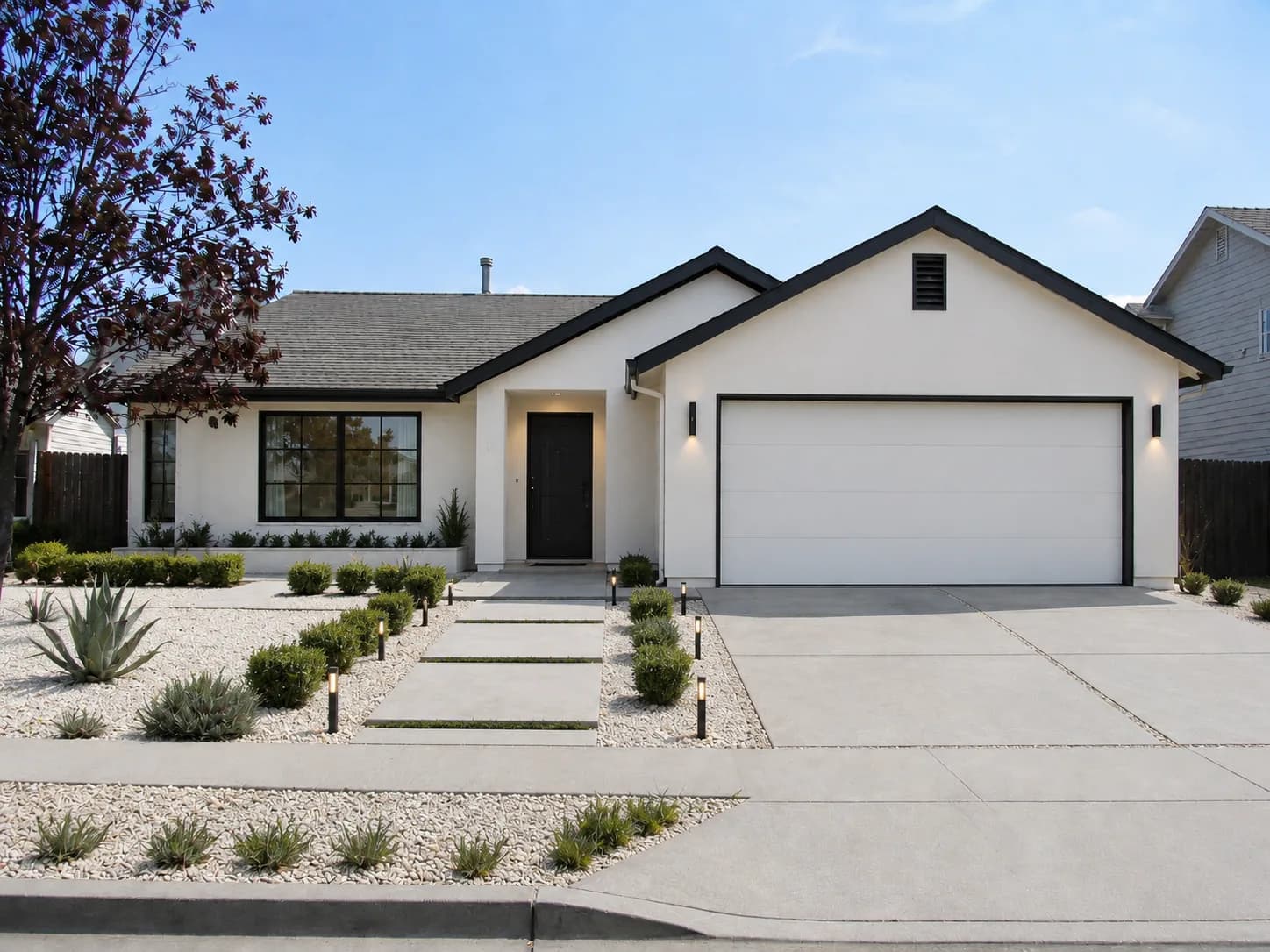
Two-car garage exterior (24×24 ft)
Walls: 96 ft perimeter × 9 ft to the eaves, plus two 24 ft gables at a 6/12 pitch. Minus one 16×7 ft garage door, one entry door and two windows. Painted fiber cement siding, two coats; 140 ft of 5.5 in trim plus both doors in a trim color.
| Siding and walls: 845 sq ft × 2 ÷ 300 | 5.63 gal |
| Exterior trim: 197 sq ft × 2 ÷ 300 | 1.31 gal |
| Buy exterior paint | 1 five-gallon pail + 1 gallon + 1 quart |
| Buy exterior trim paint | 2 gallons |
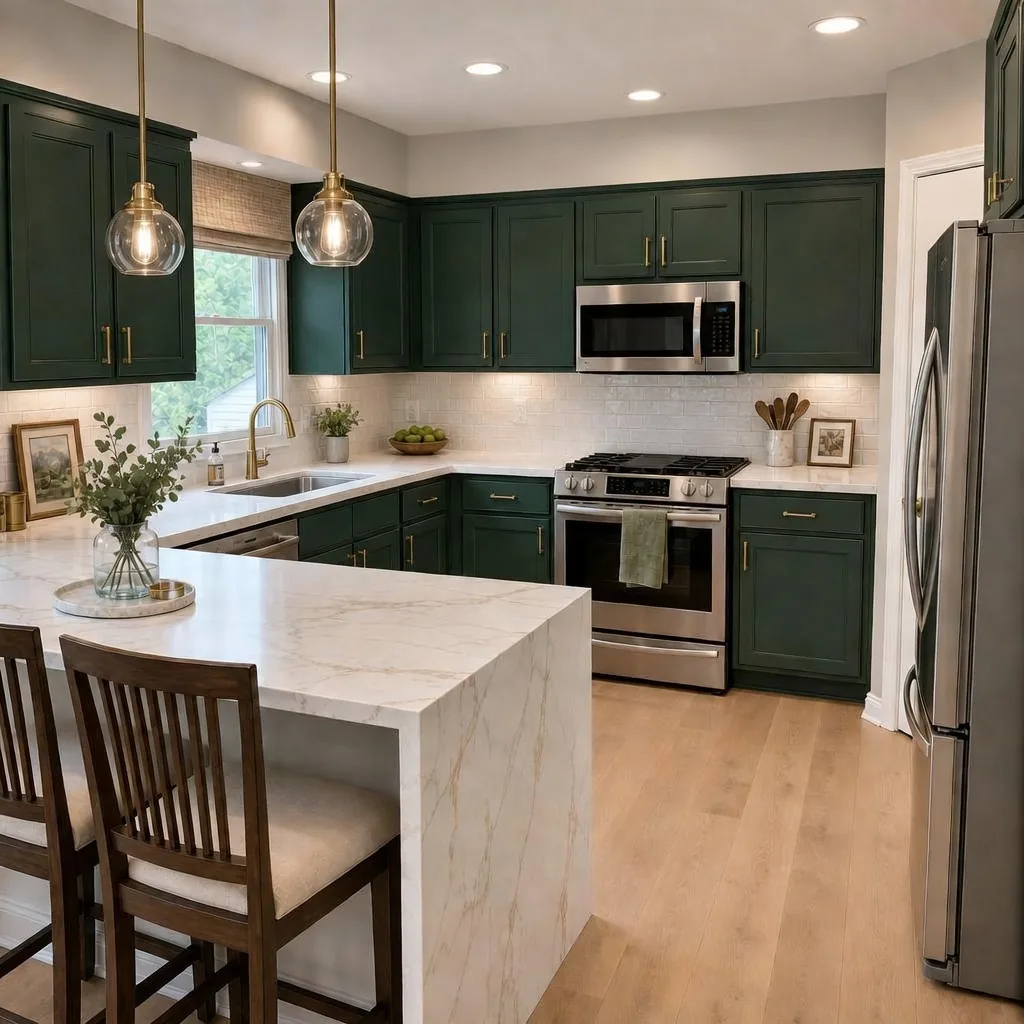
Kitchen cabinets: 20 doors and 8 drawers
20 doors at 15×30 in, painted on both sides, and 8 drawer fronts at 18×6 in. Smooth factory-finished cabinets. Two exposed end panels. Bonding primer, then two coats of cabinet enamel.
| Cabinets: 141 sq ft × 2 ÷ 350 | 0.81 gal |
| Buy cabinet enamel | 1 gallon |
| Buy bonding primer | 1 gallon |
When you need primer
Primer seals porous surfaces so the paint dries evenly, helps it grip slick or factory-finished surfaces, and blocks stains. One coat is usually enough. The calculator adds it for new drywall, bare or stained wood and unpainted masonry. Siding and cabinets need it too.
It also adds primer for a big color change. Sherwin-Williams notes that primer improves hiding and makes gray-shade primers for deep colors, and Benjamin Moore recommends tinting the primer toward the new color. If you skip primer on a big change, the calculator adds a coat of paint instead.
Common mistakes
- Planning for one coat. Coverage on the can is per coat, so two coats take twice the paint.
- Using the top of the label’s range. A can rated 350–400 sq ft per gallon is closer to 350 with a roller.
- Ignoring texture. Knockdown, popcorn, stucco and brick take more paint than a smooth wall the same size.
- Forgetting gables and vaulted ceilings, which add real area above the wall height.
- Buying paint room by room. Rooms in the same color can share cans, and from about four gallons a five-gallon pail is usually the better buy.
- Using it all up. Keep a little from the same batch for touch-ups; custom tints can be hard to match later.
Choose the color, too
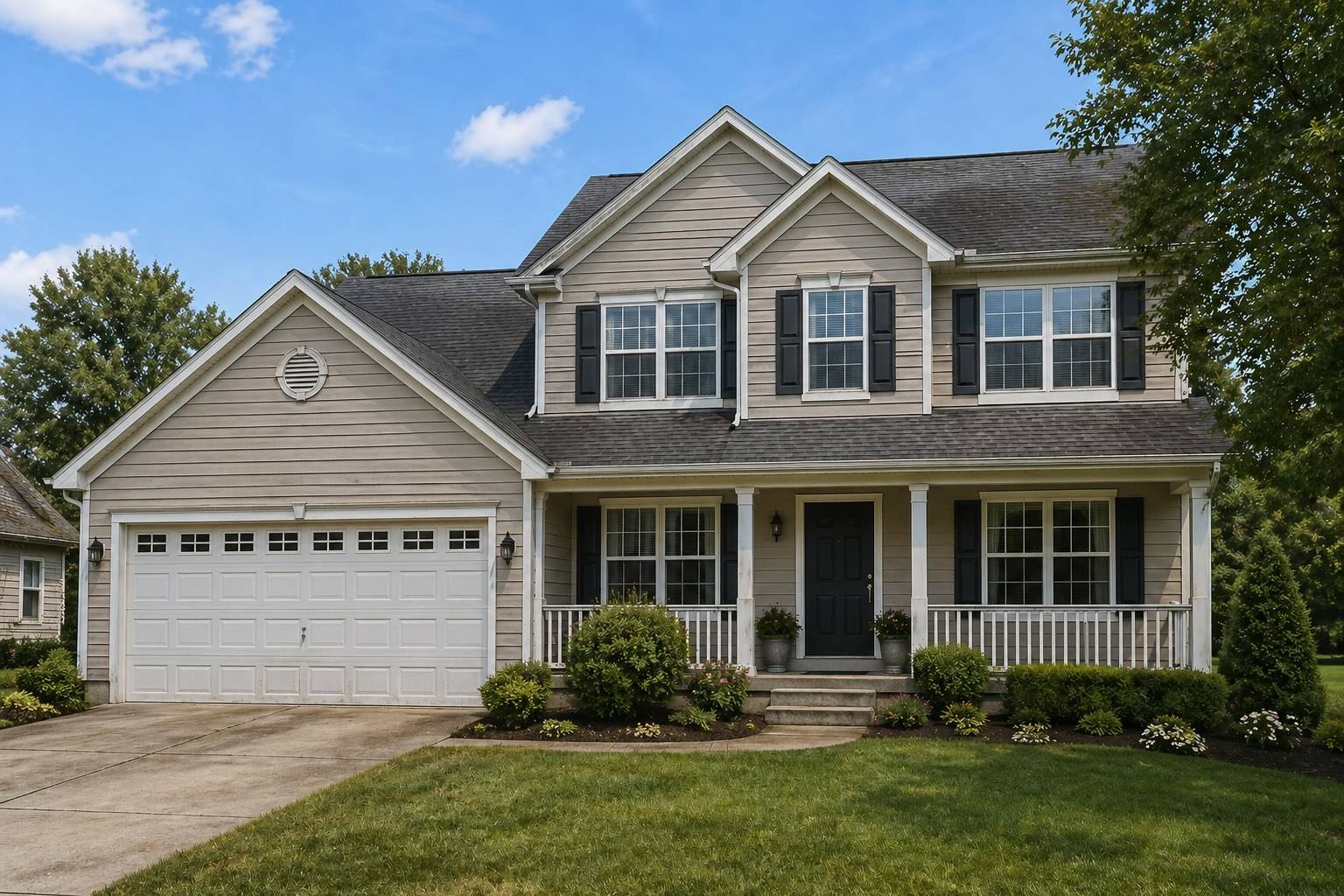
Once you know how much to buy, make sure it is the right color. The AI paint visualizer shows brand colors on a photo of your room. Still deciding on sheen? Try the paint finish selector, or pull colors from a photo with the color palette generator.